Top Signs You Need Garage Door Service – Don’t Ignore These
A garage door that squeaks is almost never the problem. A garage door that’s completely silent but takes half a second longer to reach full speed than it did last month is telling you something a lot more expensive is coming. That’s the thing about these systems: the noisy symptoms get all the attention, and the quiet ones get ignored right up until a spring lets go. If you’d rather hand the diagnosis to someone who reads these signals all day, call us at (833) 918-7067.
Key Takeaways
- Noise is usually wear, not failure. Slow, uneven, or strained movement points to components under real load.
- A door that’s silent but lagging on startup is a higher-priority warning than one that squeaks.
- You can check spring health in 60 seconds with a visual balance test before anyone comes out.
- Cleveland Park’s summer-to-winter temperature swing works steel panels and thickens lubricant, so movement changes with the seasons.
- A door that acts like the opener is dying is often a spring problem. Replacing the opener won’t fix it.
Wear Symptoms vs. Failure Symptoms: Know the Difference
Most homeowners treat every garage door complaint the same way: annoying, so maybe mention it eventually. That lumps two very different categories together. Wear symptoms are the normal service interval talking. Failure symptoms mean stop using the door.
Wear symptoms (schedule service, keep using the door carefully):
- Squeaks, grinding, or rattling that shows up in the same spot every cycle
- Minor vibration you can feel through the floor but not see in the door itself
- Weatherstripping that’s cracked, flattened, or peeling away from the frame
- Rollers that have flattened or gone noisy as they cross the track joints
- A remote or wall button that needs a firmer press than it used to
Failure symptoms (stop using the door now):
- A loud bang from above the door, after which the door won’t lift or drops fast
- A visible gap or separation in a torsion spring coil
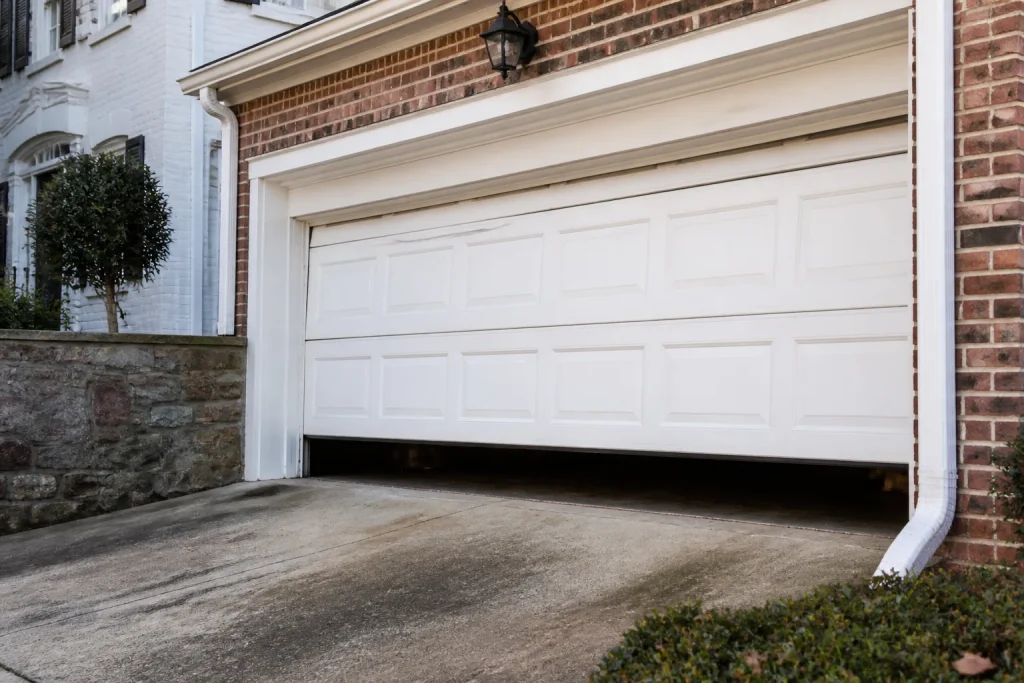
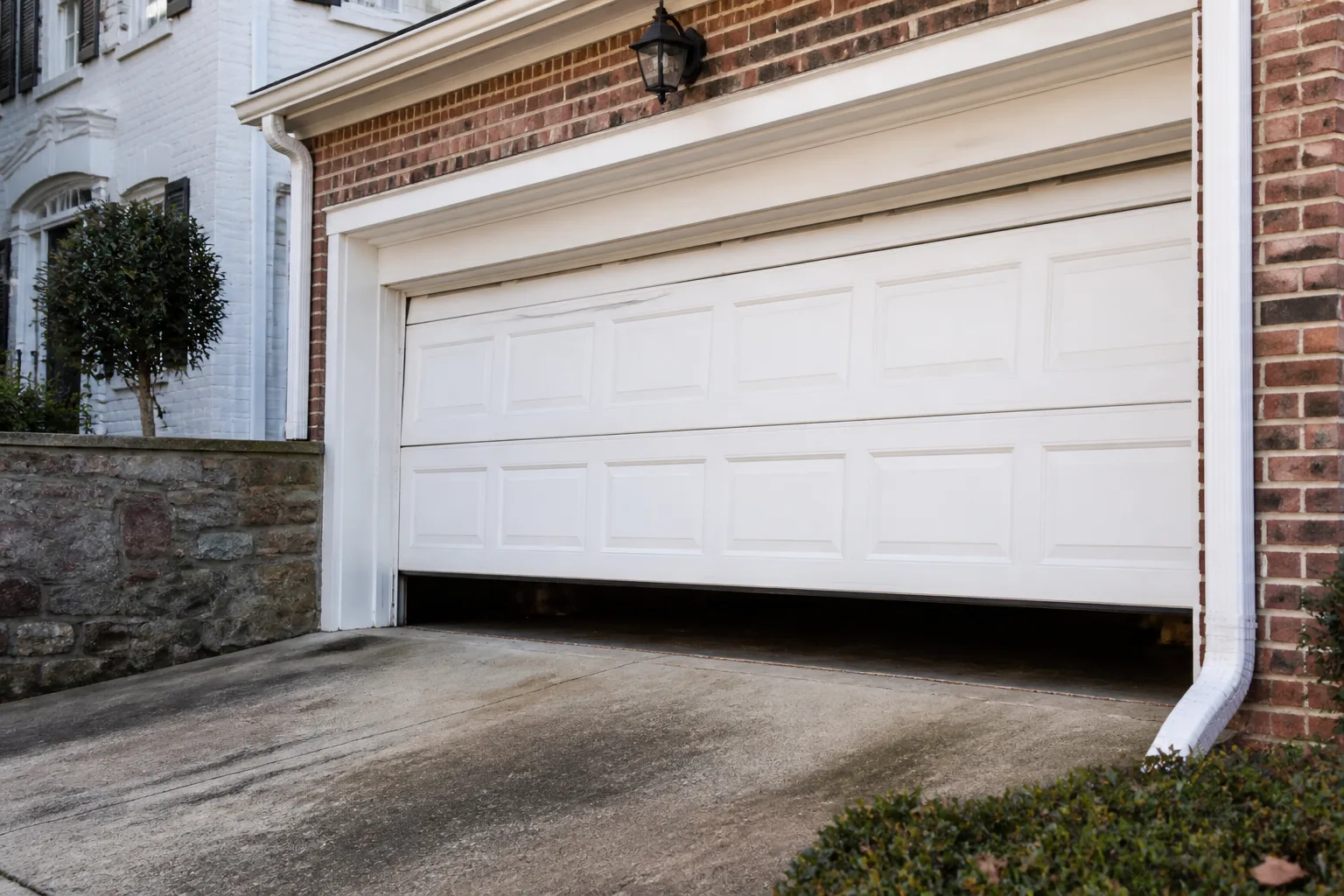
- The door hanging visibly crooked, with one side higher than the other
- Cables that are slack, kinked, or off the drum
- Any door that free-falls rather than lowering under control
Springs and cables are the genuinely dangerous part of this system. Torsion springs store enough force to cause serious injury, and they don’t give a warning before they release. If you see any failure symptom on that second list, keep the door closed and get a trained technician out. In Cleveland Park, where a jammed door means a car trapped or a house left open, that call shouldn’t wait.
Why Slow Movement and Uneven Travel Beat Noise as Warnings
Noise tells you something is rubbing. Slow, strained, or uneven travel tells you something is fighting gravity and losing. That’s the more important signal, because the components fighting hardest are the springs, the cables, and the opener’s drive system. When a door that used to rise smoothly starts easing upward or pausing partway, the mechanism is under load it wasn’t designed for.
Here’s what each pattern usually points to:
- Uniformly slow in both directions: a tired spring, or an opener working against a door that’s out of balance. The motor is compensating for a door that suddenly feels heavier.
- Fast going up, sluggish coming down (or the reverse): balance problem. The door is no longer neutral at mid-travel.
- Uneven side-to-side travel: one spring carrying more load than the other, a stretched or frayed cable, or a bent track. This one always warrants a professional look.
- Jerky, stop-start motion: binding in the track, worn rollers, or a hinge that’s seized. Often a straightforward service item, but check that it isn’t the door binding on the frame.
- Pausing or reversing near the floor: could be the safety sensors, the travel limits, or a door that’s dragging. This is where diagnosing door vs. opener matters, which we’ll come back to.
A door that has gotten noticeably slower over a season or two is the classic quiet warning. In our experience, that’s the one homeowners brush off the longest, and it’s often the cheapest to fix when caught early. A worn roller or a dry hinge is a small job. A snapped spring is not. If slow travel is happening in your Cleveland Park garage, that’s your cue to book a look before the door stops moving altogether.
The 60-Second Balance Test Any Homeowner Can Do
You don’t need tools to get a useful read on spring health before a technician arrives. The balance test tells you whether the springs are still doing their job, and it takes about a minute.
- Close the door fully and disconnect the opener. Use the manual release cord (usually red, hanging from the opener rail) to pull the door off the drive.
- Lift the door by hand to about waist height. Let go gently and step back.
- Watch what it does. A healthy door holds roughly where you left it. One that sags, drops, or needs real effort to lift is out of balance, and the springs are the usual reason.
- Reconnect the opener and cycle the door. Listen and watch for uneven travel or hesitation.
That’s it. You’re not adjusting anything, and you shouldn’t try to. Spring tension is set with winding bars and a lot of stored force, and this is one job that genuinely belongs to someone trained for it. What the test gives you is information: if your door fails the balance test, you can describe the symptom accurately when you call, and you’ll know whether to keep using the door or leave it down until a technician arrives. It’s a simple check, and it’s the one most Cleveland Park homeowners have never done. Do it on the door you use every day and you’ll know a lot more about its condition than a squeak ever told you.
How DC’s Temperature Swing Affects Your Cleveland Park Garage Door
A garage door in Cleveland Park lives through a real spread between summer and winter, and that spread shows up in the hardware. Steel panels expand in the heat and contract in the cold. The panels don’t expand at exactly the same rate as the frame around them, and over a season that difference shows up as doors that rub, bind, or sit slightly differently in the opening. If your door drags in August but clears in January, that’s not your imagination. It’s thermal expansion moving the geometry a fraction.
Lubricant behaves the same way. Grease that’s thin and free-flowing in July gets thick and sticky in January, and rollers and hinges that turned easily in the summer suddenly need more effort. That’s part of why doors feel heavier in cold weather. Add the seasonal contraction of the tracks and you get the familiar winter complaint: the door binds, the opener strains, and the whole system sounds like it’s working harder. It is.
The practical takeaway is to schedule a service look before the first big cold snap rather than after. A technician can check balance, clear and re-lubricate with a product that holds up across the temperature range, and confirm the tracks are still aligned. A door that gets looked at going into winter has a much better chance of sailing through it. In Cleveland Park, that timing matters more than the specific complaint you call about.
The Symptom That’s Almost Never the Opener
When a garage door acts sluggish, struggles to lift, or reverses before it’s fully open, a lot of homeowners jump straight to the opener. It’s the electrical part, it makes noise, and it feels like the brain of the system, so it gets the blame. In our experience, it’s usually not the opener. It’s the springs.
Here’s the mechanical reason. The springs carry the door’s weight so the opener only has to guide it. When the springs weaken, the door gets heavier than the opener is rated for, and the opener strains, overheats, or trips its safety reverse. The opener looks like it’s failing because it’s doing work it was never meant to do. Replace it with a new LiftMaster or Genie and the door still fights the motor, because the actual problem is still hanging above the tracks. That’s the expensive misdiagnosis, and we see it a lot.
This is the reason we diagnose the door and the opener as one system. A door that struggles with both a Genie and a brand-new LiftMaster hasn’t got an opener problem. A door that lifts easily but doesn’t respond to the remote has an opener problem. Those are completely different diagnoses, and guessing wrong costs you real money. If your door is struggling and you’re not sure which end of it is the problem, that’s exactly when to get the opener checked by a technician who can test the door first. We work on your brand, whatever brand it is, and we won’t recommend replacing a motor that’s working fine.
When to Call a Pro (And When You Can Wait)
You don’t need us for a squeak and you shouldn’t try to fix a spring. The useful middle ground is knowing which symptoms belong to which category.
Call now, before using the door again, if you’ve had a bang from the spring area, the door is crooked, a cable is slack, or the door free-falls. Call within the next few days if travel has gotten slow or uneven, the balance test fails, or the door binds with the season change. Book routine service if it’s noise, vibration, worn weatherstripping, or rollers that have gone loud. Squeaks and rattles are a service interval, not an emergency, but leaving a dry hinge or a flattened roller long enough does start dragging other components down with it.
Related services in Cleveland Park: for anything on the door itself, repair work starts with an accurate diagnosis. If the door has reached end of life, installation is a measure-and-schedule job rather than a repair, and pricing is set by written estimate before any work begins. And if the door won’t move at all and you’re on your way out, we offer emergency service for exactly that. One call covers the whole system, so you’re not bounced between an electrician and a door company over a symptom neither one can fully diagnose alone.
The Bottom Line
Read your door like a system, not a nuisance. Squeaks and rattles are wear, and they’re worth scheduling. Slow, uneven, or strained movement is the higher-priority warning, and it’s the one that gets ignored until a spring breaks. Run the balance test, watch how the door behaves as the seasons change, and don’t assume the opener is failing when the springs are the real culprit. Our technicians have up to 11 years of experience, they’re factory-familiar with Genie, Clopay, Amarr, and Wayne Dalton systems among others, and they’ll tell you honestly whether you’re looking at a small repair or a bigger one. If you’re in Cleveland Park and want a straight answer, we offer free estimates. Call (833) 918-7067.
Frequently Asked Questions
The earliest reliable signs are slow or uneven travel and a door that fails a simple balance test, usually ahead of any loud noise. A door that holds at mid-travel is still in balance; one that sags or needs effort to lift has weakened springs. Call (833) 918-7067 for an exact diagnosis.
Not usually. Squeaks, grinding, and rattling typically mean worn rollers, dry hinges, or a loose fastener, which are routine service items. A loud bang followed by a door that won’t lift is different: that can mean a broken spring, and the door should stay closed until a technician looks at it.
If the door lifts easily by hand but won’t respond to the remote or wall button, the opener is the likely problem. If the door itself is heavy or struggles to lift, the springs usually need attention, and a new opener won’t fix it. Call us for an exact quote, and estimates are free.
Cold thickens lubricant and contracts steel panels and tracks, so the door and hardware work harder in low temperatures. A pre-winter service that clears and re-lubricates the hardware keeps the door running smoothly through the cold months. Call (833) 918-7067 to book a seasonal check.
Learn more about our full range of service at Garage Door Repair Cleveland Park.
Written by the team at Garage Door Repair Cleveland Park.
Need Garage Door Help?
Call Garage Door Repair Cleveland Park - the local pro we connect you with is licensed and insured, here with fast after-hours help in Cleveland Park.
(833) 918-7067